How Real-Time Alerts Reduce Incidents
The operational mechanics behind a good alert pipeline.
Read article →Architecture, escalation, staffing, technology stack. A field guide to running a multi-site SOC that scales — from two sites to fifty — without doubling headcount.
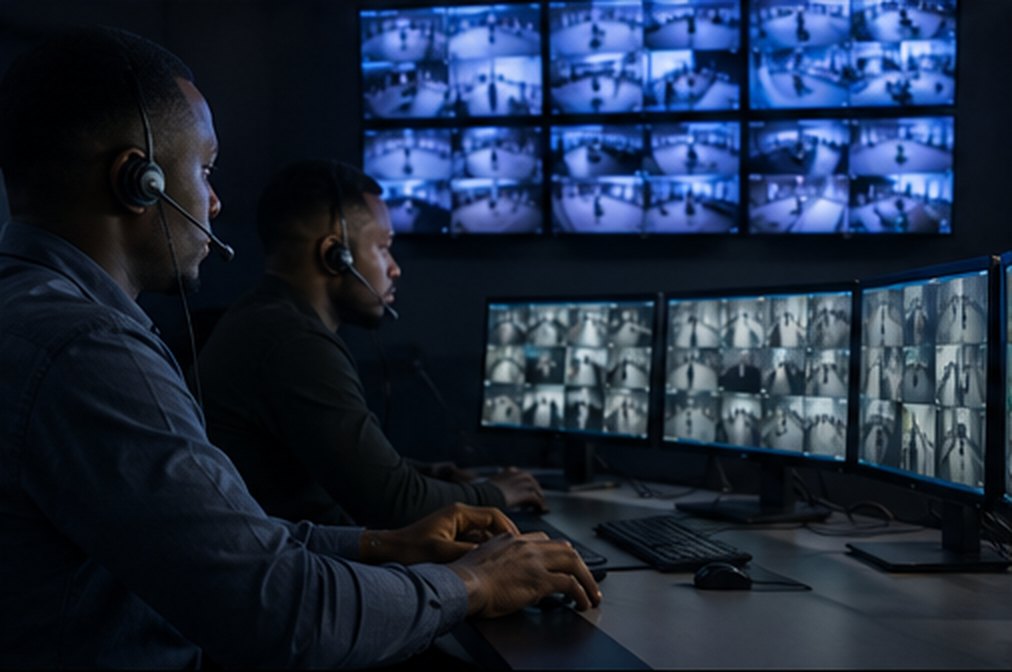
Running security operations for one site is hard. Running it for ten sites, sixty sites, or two hundred sites from a single control room — without exploding headcount and without losing operational fidelity at each site — is a different problem entirely.
The good news is that the multi-site SOC pattern is well-established. The same architectural and operational principles that work for a mall chain in Lagos, a bank branch network in Nairobi, an estate-management portfolio in Johannesburg, or a hotel group across Egypt and the UAE. This article walks through them.
A single-site operation is simple by comparison: cameras live on-site, the VMS lives on-site, operators sit in a room watching them. When something happens, response is immediate because everyone is co-located.
Multi-site adds five dimensions of complexity:
The naive solution is to stand up a dedicated monitoring room at each site. This doesn't scale: at twenty sites you have twenty rooms, twenty teams, twenty cost centres, no cross-site learning, and twenty different operational standards. The right solution is a single SOC that monitors everything centrally — using technology and operating discipline to compensate for the loss of co-location.
The architectural pattern that works for multi-site monitoring has three layers.
Layer 1 — Edge processing at each site. A small compute node at each site (or a server in the site's existing IT closet) runs the AI inference on camera feeds locally. This means real-time detection happens at the site itself, not over a remote link. It also means detection continues through brief uplink failures — the alerts queue locally and sync when connectivity returns.
Layer 2 — Cloud aggregation and dashboard. Events, metadata and incident clips flow upstream to a central cloud platform. This is what the SOC operators see: a unified dashboard across every site, every camera, every event. Cross-site analytics, watchlist distribution, and configuration management live here.
Layer 3 — Storage tier. Raw footage stays at the site (or replicated to a regional NVR for redundancy). Only event metadata and flagged incident clips travel to central storage. This dramatically reduces bandwidth requirements and keeps footage residency aligned with whatever jurisdiction each site sits in.
The bandwidth profile of this architecture is modest. A 50-camera site streaming everything to the cloud would need somewhere around 50–100 Mbps continuous. The same site running edge processing with only events and incident clips travelling upstream needs typically 2–10 Mbps — well within standard business broadband or even reasonable LTE/5G fixed-wireless. This is the architectural pattern that makes African multi-site deployments work.
The operating model in a well-functioning multi-site SOC is event-driven. Operators don't watch screens; they handle a queue of triaged events that the AI layer has surfaced as worth attention.
The lifecycle of a typical event:
Every step is timestamped, every action is logged, every operator decision is traceable.
A discovery call about your sites. We'll map how Sorveo would scale across them.
A common mistake is to assume multi-site means "more operators of the same type". The right model is tiered, with each tier handling a different category of work.
Tier 1 — Triage operators. Handle high-volume, lower-complexity event verification. Confirm real vs false positive. Categorise and route. Typical throughput: 30–80 events per shift in a well-tuned deployment. Skill profile: rapid pattern recognition, clear procedural execution, calm under pressure.
Tier 2 — Response coordinators. Handle escalated events. Coordinate physical response. Liaise with site management and external responders. Manage incident lifecycle. Typical workload: 10–25 escalations per shift. Skill profile: judgement, communication, multi-stakeholder management.
Tier 3 — Investigators / supervisors. Handle complex investigations, post-incident review, pattern analysis across sites, watchlist governance. Lower volume, higher seniority.
On-call site teams. Each site has local security or facility staff who execute physical response under SOC direction.
A typical ratio for a 30-site SOC with moderate incident profile: 3–4 tier-1 operators per shift, 1 tier-2 coordinator per shift, 1 tier-3 supervisor on day shift, with on-call rotation overnight. Total SOC headcount across all shifts: typically 12–18 people for 24/7 coverage of 30 sites. The same workload under traditional manual monitoring would require 40–80.
What the SOC actually needs to operate:
Escalation rules are where multi-site SOCs succeed or fail. Get them right and the operation runs smoothly. Get them wrong and either operators get overloaded with non-events or real events fall through the cracks.
The principles:
The metrics for measuring multi-site SOC effectiveness:
More on the alert-to-outcome flow that drives these metrics.
Six failure modes that consistently appear in multi-site operations:
With traditional manual monitoring, around 4–8 sites. With AI-augmented event triage and the right architecture, a single SOC can effectively monitor 50+ sites with the same headcount.
No. Modern multi-site architectures process most video at the edge and only send event metadata and incident clips back. This makes per-site bandwidth needs modest — often within standard business broadband.
Tiered: tier-1 operators for triage, tier-2 coordinators for response, tier-3 supervisors for investigation. Plus on-call site teams for physical response. Tier-1:tier-2 ratios of 3:1 to 5:1 are common.
Sorveo powers multi-site SOCs across Africa, including mall chains, residential portfolios, and corporate networks. Book a discovery call to see the unified dashboard.
A discovery call about your sites and how you run them today. We'll tell you whether Sorveo is a fit, and exactly how it would help.